





Event Planning in Montenegro: A Guide to Business Events and Conference Venues
Search for event planning in Montenegro and you’ll meet a wall of destination-wedding agencies. This guide is for the other job: a conference, a seminar, a training day, a product launch, a team offsite or a networking evening, run by a company that needs a room, a working projector and a hundred people fed on time.
In this story
Montenegro handles that work well, and it handles it differently from a city like Vienna or Berlin. The country is small, the coast runs on a tourist season, and the supplier pool behind any event is thinner than you’re used to. None of that is a problem if you plan around it. This guide covers when to hold your event, how to choose between the venue types available, how to size a room to your headcount, what to ask before you sign, and where the lead times will catch you out.
Why hold a business event in Montenegro?
The practical case is straightforward. Costs sit well below Western Europe for comparable quality, which matters most on the two lines that dominate an event budget — the room and the catering. Two international airports, Tivat and Podgorica, put most of Europe within a short flight, and Dubrovnik adds a third option across the border. The country is compact enough that the venue, the hotel and the airport are rarely more than an hour apart, so you’re not spending half the programme on transfers.
Then there’s the reason people actually say yes to the invitation. An offsite on the Adriatic, with a walkable old town and a mountain range an hour inland, gets a better acceptance rate than the same agenda in a business park. For an incentive trip or a leadership retreat, the location does part of the work.
The honest counterweight: this is a small market. There are fewer venues that hold 300 people than you’d expect, fewer AV companies, fewer caterers and a small pool of professional interpreters. Options run out earlier here, and they run out earliest in August.
When to hold it: the season decides almost everything
This is the variable that general event-planning advice ignores completely, because it’s written for city venues where August is the quiet month. On the Montenegrin coast, August is the opposite.
July and August are peak tourist season. Venues are booked, hotel room blocks are expensive and hard to hold, catering teams are running at capacity, and the coastal road turns a twenty-minute transfer into an hour. You can run an event then, and companies do — but you’re paying the highest rates of the year for the least flexibility, and you’re competing with holidaymakers for every hotel bed your delegates need.
May, June, September and early October are where a business event belongs. The weather is the same weather people come for, the sea is warm by June and still warm in September, and the availability and pricing are entirely different. Venues will negotiate, catering teams have room to do something interesting, and your delegates can actually get a table at dinner.
November to March is the cheapest and quietest window, and it’s fine for anything that happens indoors — a training programme, an annual kickoff, a strategy session. Just don’t sell it on the beach, and check that the venue and the hotels you’re using stay open through the winter, because plenty of seasonal businesses don’t.
What kind of venue do you actually need?
Organisers tend to search for “conference venue” and get shown three quite different products. They behave differently and they cost differently.
A hotel ballroom
The default for a conference with an overnight stay. The advantage is that everything is in one building: the room, the beds, the coffee breaks, the dinner. The trade-offs are that catering is almost always in-house and mandatory, often with a minimum spend attached; the room may be shared with a wedding on the other side of an air wall; and the AV is whatever the hotel installed, at whatever age it now is.
A conference hall or congress centre
Built for the job, usually the right answer above roughly 150 people, and typically the only option for anything that needs tiered seating or simultaneous interpretation booths. You’ll get proper capacity and infrastructure. You’ll also get a venue that’s a shell — accommodation, catering and often AV are separate contracts you have to coordinate yourself.
A business-centre auditorium or meeting suite
The sensible choice for the majority of corporate events, which are far smaller than the brochures assume: a seminar for forty, a training day for twenty-five, a workshop for a dozen, a client presentation for eight. A business centre gives you a room that was designed for people to work in rather than to dine in, AV that’s used every week and therefore actually functions, and the flexibility to book by the hour or the day rather than by the event.
Unusual venues
Fortresses, palaces, museums, wine cellars, open-air theatres and boats all exist here, and they photograph beautifully. What they cost you is infrastructure: power, shelter, accessible toilets, a kitchen, a way to get eighty people there and back after dark, and a wet-weather plan you’ll need in writing. They earn their place as the dinner or the reception, sitting alongside a conventional room where the actual programme runs.
How to size a room to your headcount
The single most common mistake in venue booking is treating capacity as one number. It isn’t. A room’s capacity depends entirely on how you seat people in it, and the difference between layouts is enormous.
Seating layouts and what they cost you in space
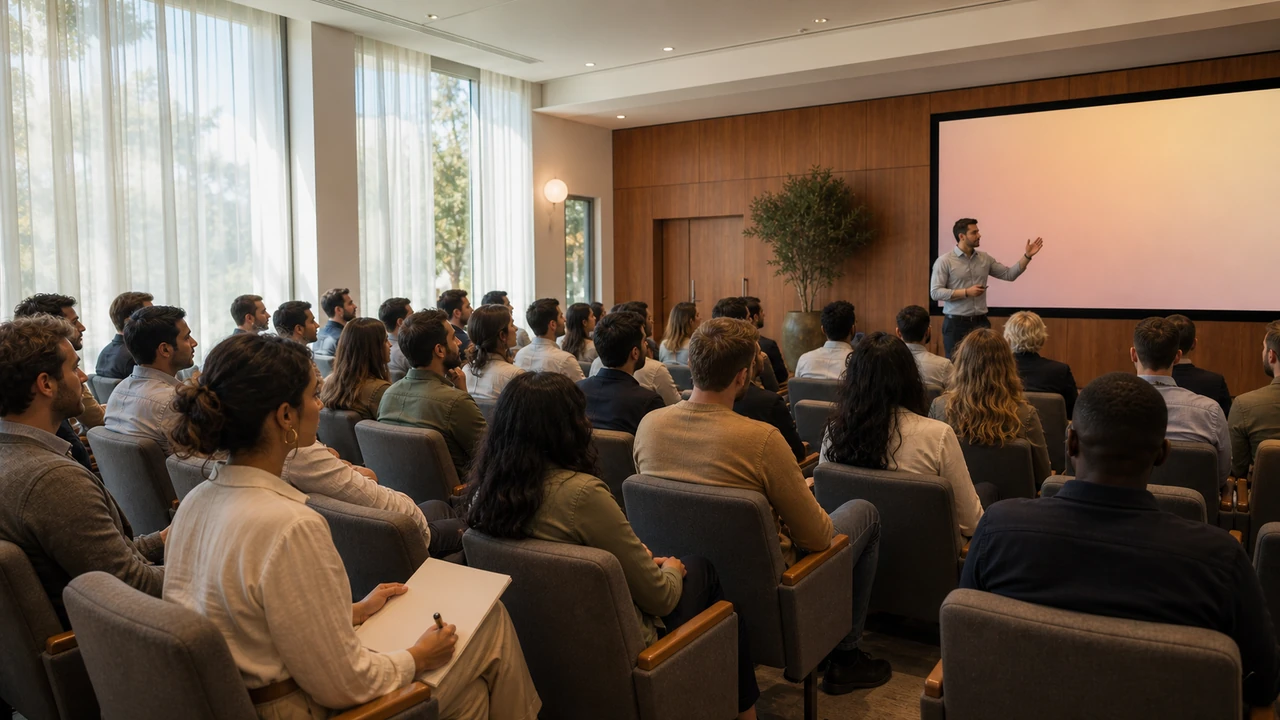
Theatre — rows of chairs facing a stage, nothing else. The densest layout there is, roughly a square metre per person. Right for a keynote or a presentation; useless if anyone needs to write.
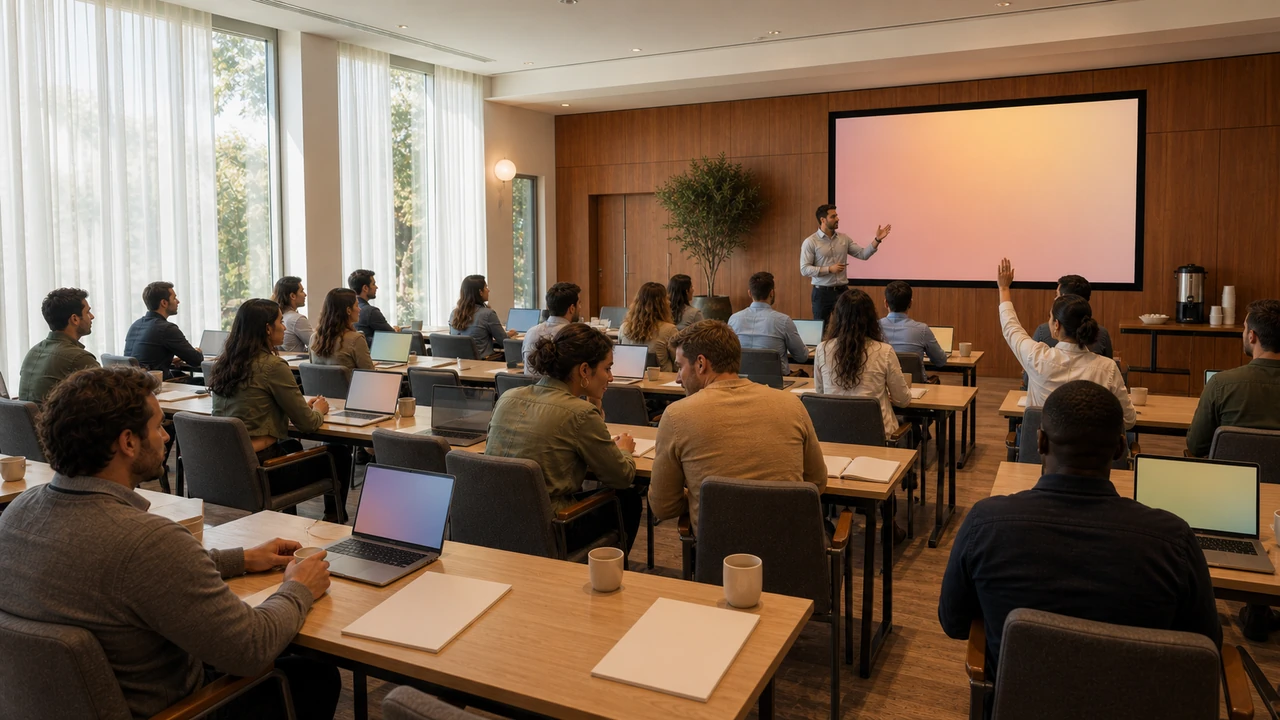
Classroom — rows of chairs at tables. Doubles the space per person compared with theatre, and it’s what you need for any session where people take notes, use a laptop or work through material.
U-shape and boardroom — everyone around one table, everyone able to see everyone. The most space-hungry layouts by a distance, and the right choice for discussion, negotiation and training with a group under about twenty-five.
Cabaret and banquet — round tables, either partly facing a stage or fully social. What you use for a dinner, an awards evening or a workshop that runs in table groups.
Stated capacity versus comfortable capacity
A venue quoting “capacity 50” is quoting its best case — theatre-style, chairs touching, nobody carrying anything. Put the same fifty people at tables and you’ll fit around half of them. Add a coffee station at the back, a camera position for streaming, and a metre of space so people can leave a row without climbing over three colleagues, and you’ve lost more.
The way to avoid the problem is to never ask “how many does it hold”. Ask instead: how many people fit in this room in classroom layout, with a projection screen at the front and a refreshment table at the back? The answer to that question is the number you can actually invite.
AV: use the venue’s kit or bring your own?
In a large market this is a budget question. In a small one it’s a scheduling question.
Venue-supplied AV is the simpler path: it’s already installed, someone on site knows how it behaves, and if it fails it’s their problem. The risk is age and specification. A projector that was bright enough in 2015 will wash out in a room with sea-facing windows, and a sound system built for background music won’t carry a panel discussion to the back row.
Bringing an external AV crew gives you exactly the specification you want, and it introduces the constraint that defines this market: there aren’t many of them. The good crews are booked out across the summer months, and so are the freelance technicians they rely on. Same for simultaneous interpreters — the pool of people who can work a business event in the languages you need is small, and in peak season it’s already committed.
The practical answer for most events: use the venue’s system for anything routine, see it working with your own laptop before you sign, and book external specialists months rather than weeks ahead if your programme genuinely needs them.
What to ask a venue before you sign
Site visits and proposal comparisons appear in every planning guide; the actual questions rarely do. If you’re booking from abroad, these are the ones that decide whether the day runs smoothly.
- How many people fit in each layout? Ask per layout, with the screen and refreshment table in place.
- Is catering in-house and mandatory, and is there a minimum spend? This is often the largest single line in the budget and the least visible in the quote.
- Can we bring an external AV crew, and what does the in-house system consist of? Get the projector brightness and the sound setup, not “full AV available”.
- Is the space exclusively ours that day? And if not, what’s happening next door — an air wall does very little against a wedding band.
- What’s the internet, and what’s the upload speed? Download figures are irrelevant if you’re streaming or running a hybrid session.
- What time can we get in to set up, and what time must we be out? A room you can’t access until an hour before doesn’t work for anything with staging.
- Where do delegates park, and can a coach reach the entrance? In coastal old towns this is a genuine problem, not a formality.
- What’s the wet-weather plan for anything outdoors, and when is the decision made? Get the deadline and the alternative room in the contract.
- What are the cancellation and headcount-change terms? Specifically how late you can adjust final numbers for catering.
Catering, suppliers and lead times
Catering is where a destination event either lands or disappoints. If the venue’s kitchen is mandatory, taste the food before you commit — a menu tasting is a normal request and a venue that resists it is telling you something. If you can bring an external caterer, you gain quality and lose simplicity, since someone then has to coordinate kitchen access, service staff and clearing.
Local produce is genuinely good here — seafood, cheeses, cured meats, wine from Montenegrin vineyards — and a menu built around it costs less and lands better with international guests than an attempt at a hotel-international buffet. That’s one of the few places where the cheaper choice is also the better one.
Everything else in the supply chain runs on longer lead times than you’d expect. Printed materials, badges and signage don’t happen same-day; branded items need weeks. Specialist equipment may come from Podgorica or across a border. Build a buffer into every supplier deadline and confirm each one twice — once when you book it and once a fortnight out.
A realistic planning timeline
Large academic conferences plan twelve to fourteen months ahead. A corporate event of fifty to two hundred people usually runs on six to nine. On the Montenegrin coast, one thing pushes that forward: the venue and the hotel rooms.
If your event falls between May and September, treat the venue decision as the first decision, roughly nine to twelve months out, and hold your hotel block at the same time. Everything else — programme, speakers, marketing, registration — can be built afterwards on a normal schedule. Off-season, three to four months is comfortable.
Bringing your event to Budva
Most corporate events here aren’t the thousand-delegate congress the destination marketing implies. They’re a training week for a relocated team, a seminar for forty clients, a strategy offsite for a leadership group, a launch evening for local partners. For those, what matters is a room that fits the format you actually need, equipment that works, a centre-of-town location people can walk to, and a venue that’s open in November as well as August.
If that’s the event you’re organising, look at what an event space in central Budva gives you before you start comparing hotel ballrooms — the room, the AV and the flexibility to book what you need for as long as you need it, without a minimum catering spend attached to the door.

Frequently Asked Questions
When is the best time to hold a corporate event in Montenegro?
May, June, September and early October. You get the weather people come for, with far better venue availability, rates and catering flexibility than July and August, when the coast is at peak tourist capacity. Winter works well for anything held indoors, provided you check that your venue and hotels stay open through the season.
How far in advance should I book a conference venue in Montenegro?
For an event between May and September, nine to twelve months, and hold your hotel rooms at the same time — that window fills early. Off-season, three to four months is usually comfortable. Book the venue and the date first; the programme can be built around them.
How many people will fit in a conference room?
It depends entirely on the layout. Theatre seating is the densest, at roughly a square metre per person; classroom layout with tables takes about double that; U-shape and boardroom take the most space of all. A room advertised for 50 people theatre-style will seat around half that number at tables, so always ask for the capacity in the layout you’ll actually use.
Do I need a local event organiser or DMC in Montenegro?
It depends on the complexity. A single-room seminar or training day at a business centre is straightforward to book directly. A multi-day programme involving transfers, several suppliers, off-site dinners and an excursion benefits from someone local who knows which suppliers deliver — particularly if you’re organising it from abroad.
What should I ask a venue before signing a contract?
Capacity in your specific layout, whether catering is in-house and carries a minimum spend, what the in-house AV actually consists of and whether you may bring your own crew, whether the space is exclusively yours that day, the internet upload speed, your set-up and vacate times, parking and coach access, the wet-weather plan for outdoor space, and the terms for changing final headcount.
Which cities in Montenegro work best for business events?
Budva has the most venues and hotel capacity on the coast and stays open year-round. Tivat offers marina-side venues and the closest airport. Podgorica is the practical choice for events involving institutions or local business, with the best year-round infrastructure. Kotor suits smaller, atmospheric events but gets congested in season.
Should I use the venue’s AV equipment or bring my own?
Use the venue’s for routine presentations, but test it with your own laptop and files during the site visit rather than trusting an equipment list. If your programme needs specific staging, streaming or simultaneous interpretation, book external specialists months ahead — the pool of AV crews and interpreters here is small and fills up over the summer.

Leave a Reply