




Conference Venues in Montenegro: How to Choose a Space and an Organiser
Most companies looking at conference venues in Montenegro are not planning a thousand-person congress. They need a room for a seminar, a training week, a sales kick-off or a leadership offsite — somewhere between twenty and forty people, two or three days, a projector that works and lunch that arrives on time.
In this story
That is the size the country serves worst. Montenegro’s event inventory is split at both ends: purpose-built convention centres on the coast sell halls of 150 to 600 seats, and business hotels offer boardrooms that stop at ten or twelve. A group of thirty falls into the gap. You end up either renting a hall built for five times your headcount, or splitting your team across two rooms that were never meant to hold a plenary session.
This guide is about closing that gap: which venue types actually work at 20–40 people, which town to put the event in, who should run it, and what moves the budget. It assumes you have already decided on Montenegro — if you are still working out timing, catering lead times and the planning sequence, that ground is covered separately.
Prices checked 21 September 2026. MONTECO rates quoted here are those published on the pricing page and include VAT. Figures are rates, not quotes — they move with the season and get revised without notice. Confirm current prices before you budget.
What size of group are Montenegro’s conference venues built for?
Look at how the market describes itself and a clear shape appears. Local destination management companies advertise a range from intimate meeting rooms of ten people up to arenas seating two thousand. The coast’s resort convention centres are built around halls of 150 to 600 seats each, with several halls under one roof and a combined capacity well over a thousand. At the other end, a good business hotel in the capital will have a main hall for around 120 theatre-style, one room that takes 40, and an executive boardroom for 20 to 25.
That last hotel is the exception rather than the pattern, and it works for a clear reason: it has one room at exactly 40 and another at 20–25, so a mid-sized group gets a room that fits instead of a room that echoes. Most properties do not offer that ladder. They have a ballroom and a boardroom, and nothing between.
The practical consequence is that your headcount, not your budget, decides how hard this search will be. Under 12 people, almost any business hotel or coworking space in the country can take you. Over 150, the resort convention centres are purpose-built and competent. Between those two numbers you have to look harder, and you have to ask a question most venues are not expecting: not “can you fit thirty people” but “what does thirty people look like in this room”.
Which venue type fits a 20–40 person event?
Three formats can hold a group this size in Montenegro. They fail in different ways, which is the useful part.
When a conference hotel is the right call
A conference hotel puts the room, the beds and the restaurant in one building. For a multi-day event with people flying in, that removes the single biggest source of friction: nobody has to be moved anywhere. It also gives you one contract and one contact instead of five.
What you give up is specialisation and control of the room. Hotel meeting space is usually a divisible ballroom, which means air walls, corridor noise from the room next door, and a ceiling and lighting rig designed for banquets rather than presentations. The AV is often adequate rather than good, and the room may need to be cleared for breakfast service. In peak season, a coastal conference hotel will also want your group to take a minimum block of bedrooms, which turns a room booking into an accommodation negotiation.
This is the right choice when your group is arriving from abroad, staying two nights or more, and the social programme matters as much as the sessions.
When a business-centre or coworking auditorium works better
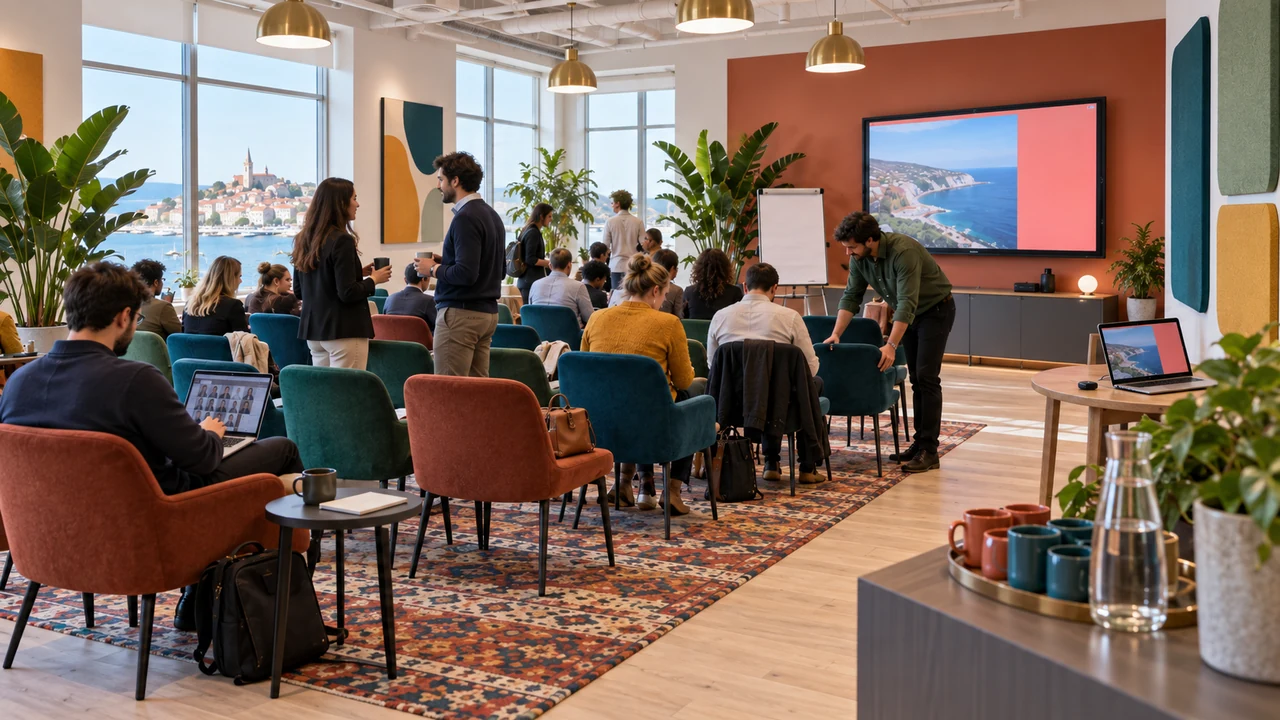
This is the category nobody writes about, and for a 20–40 person working event it is frequently the better room. A business centre or coworking space in a town centre has rooms sized for work rather than for weddings: an auditorium for a dozen, a larger flexible space for thirty or forty, and small meeting rooms next door that can absorb breakouts without a second booking.
The advantages are concrete. The furniture moves, so you can run theatre-style in the morning and café-style in the afternoon. The internet is the business’s core product rather than an amenity, which matters if you are streaming to remote colleagues. Rates are hourly with a stated minimum, so a half-day event costs a half-day rather than a day delegate rate. And the building is already full of people working, which makes it a natural place to put a team that needs desks between sessions.
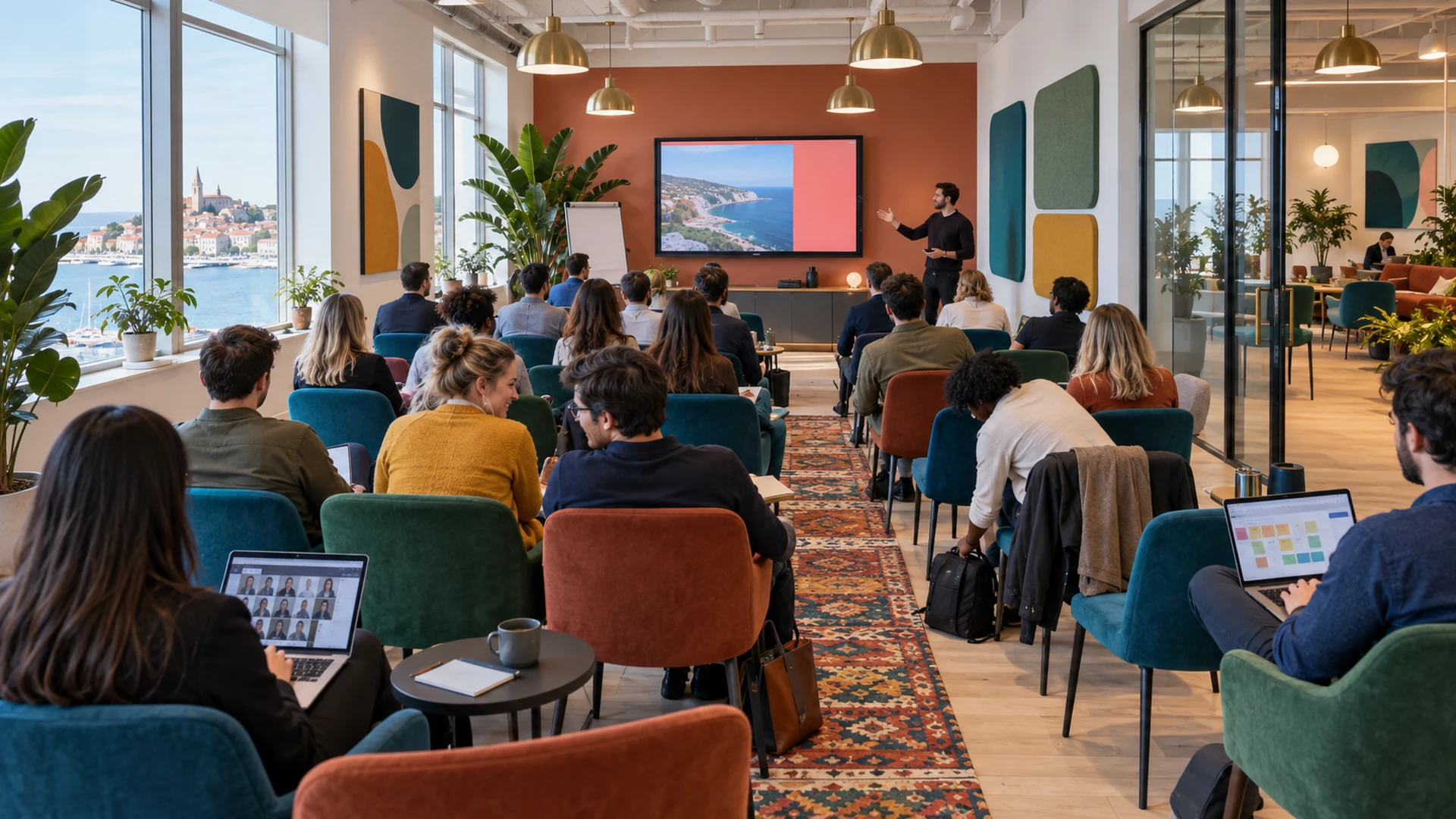
At MONTECO in Budva the ladder runs from the OKO and ICE CAVE meeting rooms at four to six people, through TALI at eight to ten, to the PRUTAS auditorium at up to twelve and the TRESTENI event space at up to forty. Guest rates are €39 an hour for the auditorium and €75 an hour for the event space, both with a three-hour minimum; residents pay €18 and €65. A forty-person seminar and its breakout groups fit in one building without renting a ballroom.
The trade-off: there are no bedrooms and usually no in-house kitchen, so accommodation and catering are separate arrangements. In a town centre that is a short walk rather than a logistics problem, but it is two more suppliers to brief.
When to take it somewhere unusual
Montenegro has fortresses, stone terraces, wine cellars, villas and boats, and a dinner or an awards evening in one of them is what people remember from the trip. As a working venue, though, these spaces are a poor substitute for a room with walls. Daylight defeats projectors, wind defeats microphones, and the sea defeats concentration.
Treat the unusual venue as the evening half of the programme and keep a conventional room for the sessions. Trying to make one space do both is the most common way a well-funded offsite ends up with a keynote nobody could hear.
Where in Montenegro should you hold it?
The country is small enough that every town is reachable from every airport in under two hours, and different enough that the choice still changes the event. You will get contradictory advice on which city is “best” for business events — some put the capital first for its infrastructure, others the coast for the programme — and both are right, because they answer different briefs.
The rule that resolves it: if the event is the whole reason people are travelling, go where the logistics are simplest. If the place is part of the point, go to the coast and accept a longer transfer.
Budva and the central coast
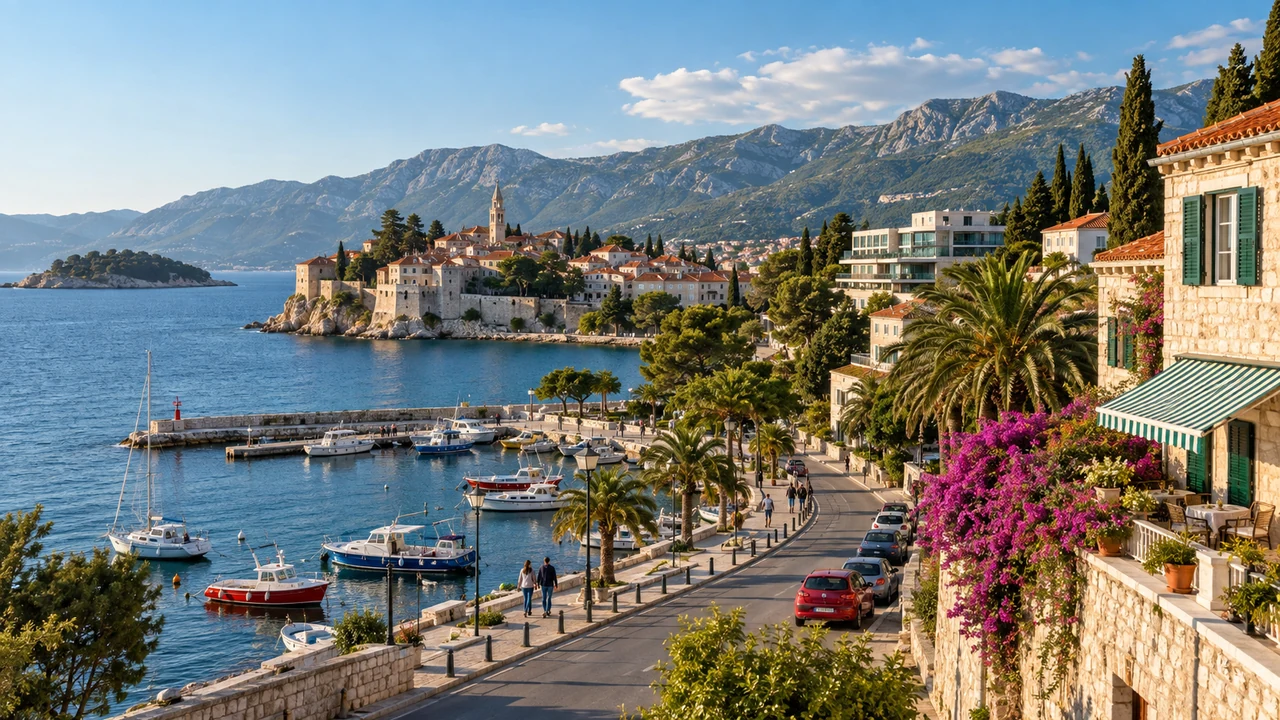
Budva has the densest concentration of hotel rooms, restaurants and event suppliers on the coast, and it stays open year-round in a way the smaller coastal towns do not. Tivat airport is about 20 km away — roughly 25 to 30 minutes outside the season, but budget a full hour in July and August, when the coastal road backs up badly. Podgorica airport is 60 to 65 km, which is an hour to an hour and a half depending on traffic.
It suits a 20–40 person offsite well: you can run sessions in the morning, put people on a boat or in Kotor in the afternoon, and have dinner without anyone getting back in a van for an hour.
Podgorica
The capital is where the country’s business-grade conference infrastructure sits, and the airport is about 12 km from the centre — the shortest airport transfer in Montenegro. There is no coastal road to get stuck on and no season to plan around. For a pure working event where people arrive, sit in a room for two days and fly out, Podgorica is the efficient answer.
What it does not give you is a reason to be in Montenegro. If part of the purpose is that people come back talking about the trip, the capital will not do that work for you.
Tivat and the Bay of Kotor
Tivat has the airport and the marina, and Kotor is only about 8 km away — ten to fifteen minutes through the tunnel. The bay is the most photographed setting in the country and the venues there skew boutique and expensive. Capacity in the 20–40 range exists but is thinner than in Budva, so availability rather than price is usually the constraint.
This is the right base for a small senior group where the setting is doing real work: a board offsite, a client incentive, a leadership retreat.
Is it a conference or an offsite? They need different rooms
These get booked from the same search and need almost opposite things, so decide which one you are running before you look at a single room.
A conference is content-led. People come to hear something, the room faces forward, and the day is built around a schedule. What you need is sightlines, sound, a screen everyone can read and a foyer where coffee does not block the doors. Sessions end, people leave.
An offsite is group-led. The same thirty people stay together for two or three days, and the work happens in conversation rather than presentation. That changes the room requirement completely: you want furniture you can rearrange several times a day, wall space for output that stays up overnight, breakout corners, and somewhere to go when a session ends that is not the hotel lobby. A room you have to clear every evening costs you the start of every morning.
How a three-day offsite usually runs
The dominant shape is simple: work in the morning while people are sharp, an activity or excursion in the afternoon, dinner together in the evening. Three days of it gives you roughly nine hours of real working time, which is less than most teams plan for.
The trap is the dead time. An afternoon activity that needs a 50-minute transfer each way eats the whole afternoon and half the group’s patience. Keeping the activity within twenty minutes of the base is worth more to the programme than a more impressive destination further away.

The other thing teams underestimate is that people still have jobs. On a three-day offsite somebody will need to take a call, clear a queue or join a meeting back home. Somewhere with desks, decent bandwidth and a phone booth turns that from a disruption into a non-event — which is one reason a workspace-based venue suits offsites better than a resort does. For teams staying longer, a private workspace for the team can cover the offsite and the working weeks around it under one arrangement.
Who should organise it: the venue, an event organiser, or your team?
Every agency page in this market advertises the same turnkey scope — transfers, accommodation, venue, AV, team-building, dinners — and none of them explain which parts you should keep. Here is the split that works.
Keep in-house the agenda, the content, the speakers, the attendee communication and the decision about what the three days are for. No external supplier can do these, and handing them over is how offsites end up as a sequence of activities with no point.
Give the venue the room, the layout, the AV, the coffee and the on-site running of the day. A venue with its own event coordinator can handle a 20–40 person single-site event end to end. For a one-day seminar in one building, this is usually all the help you need.
Bring in an event organiser or a destination management company when the event moves: airport transfers for people arriving on different flights, accommodation across more than one property, an excursion with its own operator, a gala dinner at a second venue. The value is local supplier relationships and someone in-country when a coach does not turn up — not the venue booking itself, which you can usually do directly.
That last point deserves a warning, because the search results actively mislead here. Query event organizer in Montenegro or event management in Montenegro and the first two pages are almost entirely destination-wedding planners. They are good at what they do, and what they do is not a corporate seminar. Corporate operators in this market describe themselves as MICE — meetings, incentives, conferences, exhibitions — so that acronym is the fastest way to filter a supplier list. If a company’s site talks about ceremonies, florals and photographers, you have found a different industry.
What drives the cost of a corporate event in Montenegro?
Four things move the number, and the room rate is the smallest of them.
Season. The coast runs on a tourist calendar. From May to September you compete with holiday demand for rooms, restaurants and drivers, and rates reflect it. Outside those months the same venues are quieter, more negotiable and easier to book at short notice — though some suppliers drop to shorter working weeks in winter, so confirm availability rather than assuming it.
Headcount, and the buffer around it. Plan the room for 20–25% more space than your minimum estimate. A room filled to its rated capacity is uncomfortable for a working day, and the cost of the next size up is almost always less than the cost of a cramped session.
Add-ons. Across the industry, AV, catering and labour routinely add 30–50% on top of a quoted base rate. Ask for an all-in figure at the quoting stage, not a room rate, and get the AV specification in writing — this is where event budgets most often break.
Minimum booking blocks. Most event space is sold with a minimum. At MONTECO the auditorium and the event space both carry a three-hour minimum, so a two-hour workshop is priced as three hours. Building the agenda around the block, rather than paying for time you do not use, is usually worth an hour of planning.
Published hourly rates give you a floor to measure quotes against. A full guest day in the TRESTENI event space at €75 an hour is a different order of cost from a day delegate package at a resort, and knowing the floor tells you what the package is actually buying.
Putting a 40-person event in Budva
The short version of everything above: decide your headcount and your format first, then look for a room that was built for that number rather than one that can technically hold it. For 20 to 40 people, that usually means a flexible business venue in a town centre rather than a ballroom or a boardroom — close to beds and restaurants, with furniture that moves and rooms next door for breakouts.
Budva makes that straightforward. It works outside the season as well as in it, and both airports are within a comfortable transfer. MONTECO sits in the centre with the TRESTENI event space for up to forty people, the PRUTAS auditorium for up to twelve, bookable meeting rooms for breakouts and a floor of desks for the hours between sessions.
Frequently Asked Questions
How far in advance should I book a conference venue in Montenegro?
Three to six months is enough for most 20–40 person events, and that is the horizon local suppliers work to. For a coastal venue in July or August, or any event that needs a block of hotel rooms, push it to six to twelve months. The twelve-to-eighteen-month lead times quoted for premium venues in large markets do not apply here.
Is Budva or Podgorica better for a corporate conference?
Podgorica if the event is purely a working one — the airport is about 12 km from the centre and there is no season or coastal traffic to plan around. Budva if the setting is part of the purpose, or if the programme includes anything beyond the room.
Can a group of 20 to 40 people find a suitable venue in Montenegro?
Yes, but it takes more searching than either a smaller or a larger group. Convention centres are built around halls of 150 seats and up, and most hotel boardrooms stop near a dozen. Business centres and coworking venues with flexible rooms are usually the closest fit in this range.
What does an event organiser in Montenegro actually do?
Airport transfers, accommodation across properties, venue sourcing, AV, excursions and dinners — the logistics that sit between suppliers. You are paying for local relationships and someone on the ground, so the value rises with how much the event moves. A single-site event in one building often needs only the venue’s own coordinator.
How long is the transfer from Tivat airport to Budva?
About 20 km, which is 25 to 30 minutes for most of the year. In July and August the coastal road can stretch that to an hour, so build peak-season arrivals around the longer figure. Podgorica airport to Budva is 60 to 65 km, or an hour to an hour and a half.
Is it cheaper to hold a corporate event in Montenegro out of season?
Generally yes on the coast, where rates track holiday demand from May to September. Off-season also buys you availability, shorter transfers and more negotiating room. Check that your suppliers keep full working weeks in winter, as some reduce their hours.
What should a conference venue include for a working event?
Furniture you can rearrange, a screen readable from the back row, sound that covers the room, internet that holds up when everyone connects at once, and a breakout space or second room. For anything over a day, wall space you can leave output on overnight matters more than most buyers expect.


Leave a Reply