





Cost of Living in Montenegro: A Real Monthly Budget for Remote Workers
Search the cost of living in Montenegro and you’ll get numbers that don’t agree with each other. One guide says €700 a month, another says €1,500, a forum thread says both are right depending on where you sleep. They’re all describing the same country — they’re just quietly averaging over a coastal town in August and a capital-city flat in February, which are not the same expense at all.
In this story
This guide separates them. You’ll find rent broken down by city and by season, what utilities actually run to in a Montenegrin winter, realistic food and transport figures, and three worked monthly budgets you can compare against your own income. Coworking is included as its own line, because for anyone working remotely it belongs in the budget rather than in the footnotes.
Prices checked 21 July 2026. Figures here are given as ranges, because costs in Montenegro move with the season, the town and the street. Rents in particular are revised twice a year on the coast, so treat these as a guide for planning and confirm current numbers before you commit to anything. Anything touching residency, taxes or visas is outside the scope of this guide — those rules change and should be confirmed with a qualified local adviser rather than a blog post.
What does it cost to live in Montenegro?
Three brackets cover most people. A lean single budget runs about €800–1,000 a month: a modest flat outside the centre or a shared place, cooking at home, buses rather than a car. A comfortable single budget is roughly €1,200–1,800 — your own one-bedroom, eating out a couple of times a week, a coworking membership, occasional taxis. A couple lands around €1,800–2,500, and a family of four typically between €2,000 and €2,800 depending mostly on schooling and housing.
For context, the average local net salary sits around €700–900 a month. That gap explains a lot about the rental market: anyone earning a Western remote salary is competing for flats with people earning local wages, comfortable if you are the newcomer, and part of why coastal rents have climbed.
Rent is the variable that decides which bracket you’re in. Everything else — food, utilities, transport — moves within a fairly narrow band. Housing can double.
How much is rent in Montenegro, city by city?
This is where national averages stop being useful. A one-bedroom flat costs one thing in Podgorica in January and something else entirely in Budva in July, and most published figures blend the two into a number that describes nowhere.
Budva and the coast, in and out of season
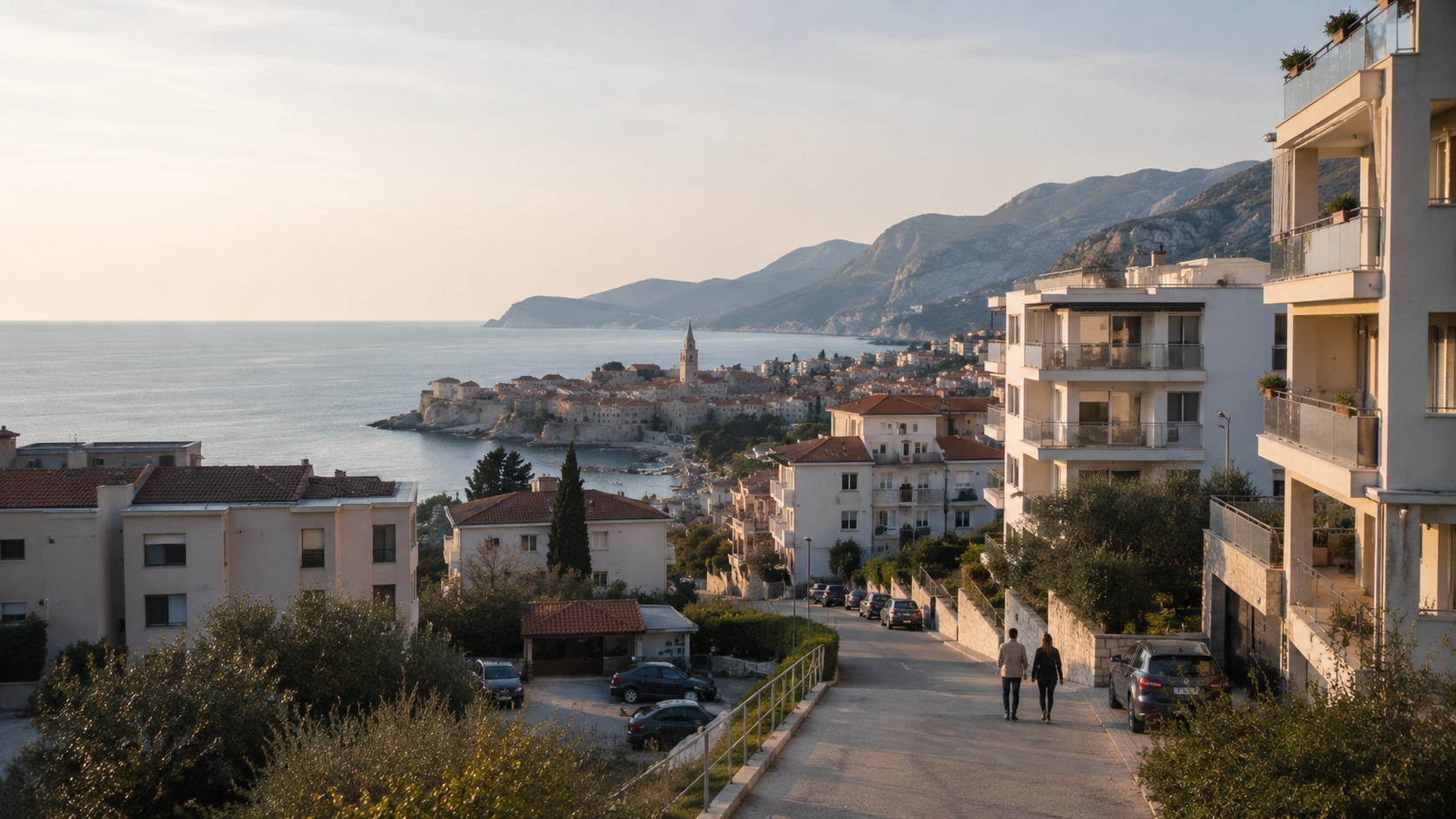
Budva runs on tourism, and the rental market follows. Off-season, a one-bedroom typically goes for €500–800 a month; between June and September the same flat is advertised at €700–1,200. Two-bedrooms move from roughly €800–1,400 off-season to €1,200–2,000 at peak. Compare a quiet winter month against a short summer let and the gap can reach 50–70%.
The practical consequence: what you pay depends less on the flat than on the month you signed. Arrive in July looking for somewhere to live and you’ll be quoted the season. Arrive in October and you’re negotiating with a landlord facing eight empty months.
Podgorica: the year-round option
The capital has no tourist premium, so prices barely move across the year: a one-bedroom sits at about €400–600, a two-bedroom at €600–1,000. It’s the cheapest and steadiest place to live in the country, with the best day-to-day infrastructure, and it’s inland — which is either the point or the problem, depending on why you came.
Kotor, Tivat and Herceg Novi
The rest of the coast sorts itself by prestige. Kotor runs €550–900 off-season and €800–1,200 in summer for a one-bedroom, with winters noticeably darker and cooler because the town sits deep in the bay. Tivat is the priciest, at €650–1,000 rising to €900–1,500, driven by the marina development. Herceg Novi is the value option at €400–700, going to €600–1,000 in season.
Rent ranges above reflect asking prices in July 2026. Coastal rates are reset for each season, so a figure quoted in winter and the same flat in July are effectively two different markets — check what is being advertised for the month you plan to arrive.
Expect to put down one to two months as a deposit, and expect the search itself to take longer than it would at home — a good share of the market never reaches the listing sites and moves through local agents and word of mouth instead.
Utilities, internet and the winter bill nobody warns you about
For an 85 m² flat, budget €110–150 a month across electricity, water, heating and rubbish collection. That figure holds for most of the year and then breaks in winter.
Much of the coastal housing stock was built for summer occupancy, with thin insulation and an air conditioner doing double duty as the heating system. Running it through a cold, damp January pushes the electricity bill toward €250–280 a month. It’s the single most common unpleasant surprise for people who arrived in warm weather and signed for a flat without asking how it’s heated.
Internet is the good news. Fibre is standard in the cities at €25–35 a month, and mobile plans run €10–25. Speeds are genuinely fine for video calls — with the caveat that residential connections in coastal towns feel the summer population surge, which matters if your income depends on a stable call at four in the afternoon.
Everyday costs: food, restaurants and getting around
Groceries
A single person spends €180–350 a month on food, depending mostly on how much of it comes from the supermarket versus the market. Staples are inexpensive: milk around €1.00–1.70 a litre, a dozen eggs €1.90–3.35, chicken breast €4–6.50 a kilo, potatoes under €1, tomatoes about €2. Imported goods carry a noticeable premium, which is where budgets quietly inflate.
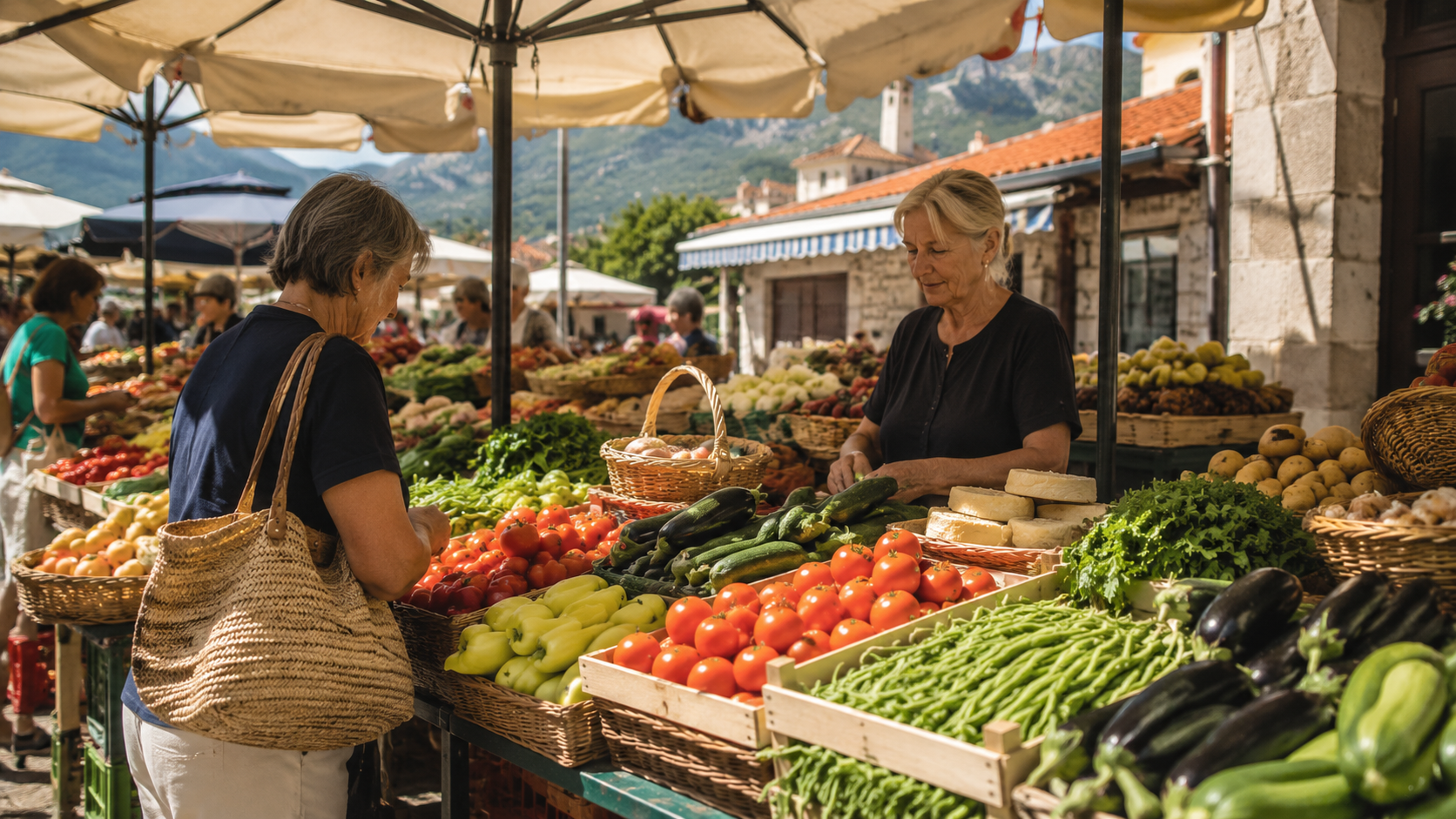
The pijaca — the open-air market in every town — undercuts the supermarket chains on fruit, vegetables and cheese, and the quality is better in season.
Eating out
A simple local meal costs €7–15. Three courses for two in a mid-range restaurant runs €30–55, coffee €1.30–3.00. A konoba, the traditional family tavern, will rarely take more than €12 a head including a drink.
Location is the multiplier. A restaurant on the Budva strip or against the Old Town walls charges 30–50% more than one three streets inland for a comparable plate — the view is the product.
Getting around
A local bus ride is about €1.00–1.25 and a monthly pass €30–40. Intercity buses are cheap and frequent: Podgorica to Budva costs around €5–7. Taxis run roughly €1 a kilometre, so a five-kilometre hop is about €3.50.
Petrol is €1.50–1.95 a litre. Whether you need a car depends entirely on where you settle: in Podgorica or central Budva you can live without one, but public transport thins out quickly along the coast and in the mountains, and a car stops being a luxury the moment you live somewhere with a view.
Healthcare and insurance
Private international health cover for a foreigner typically costs €40–100 a month, depending on your age and the level of cover. A consultation at a private clinic is around €27, common medications are inexpensive, and private care is the route most newcomers take for anything routine.
What insurance you’re obliged to hold, and what any residency route requires, is a legal question rather than a budgeting one — the requirements change, so confirm them with a qualified adviser or a locally licensed insurer before you rely on any figure.
Working from Montenegro: the budget line most guides forget
Every cost-of-living guide prices your flat and your groceries and then assumes you’ll work from the kitchen table. For a few weeks, you will. Then August arrives, the flat above fills with holidaymakers, the air conditioning becomes the loudest thing in your calls, and the connection slows exactly when the town is at its busiest.
Budget €100–300 a month for somewhere to work. In Budva, a day at MONTECO costs €15, half a month is €140 and a full month €280, with VAT included — so if you come in two or three days a week, you’re looking at €140 rather than €280. Meeting rooms are billed by the hour from €10 for members when you need a room with a door for a client call.
Set against a €600 flat, a desk looks like an extra. Set against one lost client call in the middle of the season, it doesn’t. It also solves the problem nobody budgets for at all: in a country you’ve just moved to, a workspace is the fastest way to meet people who aren’t on holiday.
What your remote salary actually buys here
Montenegro is cheaper than Western Europe by a wide margin and cheaper than most of its neighbours by a narrow one. Everyday costs run roughly 13–17% below Croatia, which has grown notably more expensive since joining the eurozone, and about 4% below Serbia. Albania is 13–16% cheaper still, though with weaker infrastructure. Germany is around 37% more expensive.
In practical terms: a remote salary that covers a small flat and little else in Berlin or Amsterdam supports a one-bedroom by the sea, a coworking membership, restaurant meals and savings in Budva. What it doesn’t buy is Southeast Asian pricing — this is European infrastructure at modest European prices, not €500-a-month living.
One detail that removes a whole category of friction: Montenegro uses the euro despite not being an EU member. No conversion, no exchange-rate management, no watching a local currency slide against your invoices.
Three monthly budgets you can compare against
Rounded, realistic, and including a workspace.
Lean single, Podgorica — about €1,050. One-bedroom outside the centre €450, utilities and internet €140, groceries €200, eating out €60, transport €35, coworking half-month plan €140, phone €15, buffer €10. That is a workable life rather than a frugal one, provided you cook most days.
Comfortable single, Budva — about €1,600. One-bedroom off-season rate €650, utilities and internet €160, groceries €280, restaurants and coffee €180, transport €50, full coworking month €280. Signed in winter rather than summer, this holds through the year.
Couple, Budva — about €2,370. Two-bedroom €950, utilities and internet €190, groceries €450, eating out €300, transport including a modest car €200, one coworking membership €280. A second membership takes it to roughly €2,650.
Swap Budva for Herceg Novi and each coastal budget drops by €100–150. Arrive in June without a contract and the same budgets rise by €200–400 for the season. Current rates for every workspace plan are on the MONTECO pricing page.
Budgets above are built from July 2026 prices and rounded. Utility costs shift with the season, rent shifts with the month you sign, and workspace rates are the ones published on the pricing page at the time of writing — check it for today’s figures.

Choosing where to base yourself
The honest summary: Montenegro costs a single person somewhere between €1,000 and €1,800 a month depending on the town and the month you signed your lease, and a couple around €2,400. Podgorica is cheapest and steadiest. Budva costs more and gives you the sea, provided you sign off-season and heat the flat properly. Herceg Novi splits the difference.
The move that saves the most money isn’t choosing a cheaper town — it’s arriving in autumn, taking a twelve-month contract at the off-season rate, and knowing what the winter electricity will be before you sign. Everything else is within a couple of hundred euros either way.
If a desk that works year-round is part of that plan, a coworking day pass in Budva is the cheapest way to test both the workspace and the town before committing to either.
Frequently Asked Questions
How much do you need to live comfortably in Montenegro?
About €1,200–1,500 a month for one person in Podgorica and €1,400–1,800 on the coast, covering a one-bedroom flat, food, transport and a workspace. A couple should plan for roughly €1,800–2,500.
What is the cheapest city to live in Montenegro?
Podgorica. The capital has no tourist premium, so rent stays flat year-round at roughly €400–600 for a one-bedroom, and everyday services are cheaper than on the coast. Among coastal towns, Herceg Novi is the most affordable.
Can you live in Montenegro on €1,000 a month?
In Podgorica, yes — with a modest flat outside the centre and cooking at home. On the coast it’s difficult outside the winter months, and in Budva during summer it isn’t realistic unless your rent is already fixed by a long-term contract.
How much is rent in Budva?
A one-bedroom runs about €500–800 a month off-season and €700–1,200 from June to September. Two-bedrooms go from €800–1,400 to €1,200–2,000. Signing a twelve-month contract in autumn is the way to hold the lower rate.
How much do coastal rents rise in summer?
Long-term asking prices climb roughly 20–40% between June and September. Compare a winter monthly rate against a short summer let and the difference reaches 50–70%, which is why the month you sign matters more than the flat you choose.
Is Montenegro cheaper than Croatia?
Yes, by roughly 13–17% on everyday costs, a gap that widened after Croatia joined the eurozone. Montenegro is around 4% cheaper than Serbia and about 37% cheaper than Germany, while Albania remains cheaper still.
How much does coworking cost in Budva?
At MONTECO a day pass is €15, half a month €140 and a full month €280, VAT included, with meeting rooms from €10 an hour for members. Budget €100–300 a month for a workspace — worth planning for, since summer flats on the coast are noisy and their connections slow when the town fills up.



Leave a Reply