





What Is a Coworking Space? A Complete Guide to How Coworking Works
A coworking space is a shared, fully equipped workplace where people from different companies work side by side on flexible membership terms instead of signing a long office lease. You get a desk, fast internet, meeting rooms, and a professional setting the day you join — and you can leave or scale up when your needs change. This guide explains what coworking is, where it came from, how it works in practice, who it suits, and how it compares with a traditional office, so you can decide whether it fits the way you work.
In this story
What is a coworking space?
At its simplest, coworking means sharing a workspace with people who don’t work for your company. A coworking space rents you access — a seat, a private room, or just an address — and bundles in everything an office normally requires: Wi-Fi, furniture, cleaning, utilities, printing, and rooms you can book for calls or meetings. Instead of one tenant on a multi-year lease, the building holds freelancers, remote employees, small teams, and sometimes large companies, each paying a membership for the space they use.
The word carries two ideas at once: the physical place, and the way of working in it. Members work independently on their own projects, but they share the same floor, kitchen, and events — which is where the community and networking that coworking is known for come from. That mix of independence and shared space is the core of what coworking means, and it’s what separates it from simply renting an office or working from a café.

A short history of coworking
Coworking is younger than it feels. The first space to use the name opened in San Francisco in 2005, when software engineer Brad Neuberg set up a room where independent workers could keep their freedom but escape the isolation of working alone. The idea spread as laptops, cloud tools, and remote work made location less important, and it grew from a handful of community rooms into a global category used by individuals and corporations alike. The model keeps evolving — toward larger corporate sites on one end and smaller neighbourhood spaces on the other — but Neuberg’s original aim, independence without isolation, still describes it well.
How does a coworking space work?
You join a coworking space the way you’d join a gym: pick a membership that matches how often you’ll be there and what you need, then use the space under that plan. There’s no build-out, no furniture to buy, and no utility bills — the operator handles all of it, and the cost is folded into your membership. What differs between members is mostly the type of access they pay for.
Membership tiers: hot desk, dedicated desk, and private office
Most spaces sell access in three tiers. A hot desk lets you take any free seat in the open area, booked by the day or month — the flexible, lower-cost option for people who don’t need the same spot each time. A dedicated desk is one workstation reserved for you alone, so you can leave a monitor and notebooks overnight and always sit in the same place. A private office is a lockable room for a person or team that wants privacy and quiet. Many people move up the tiers as they settle in or as their team grows.
Day passes, hoteling, and booking
You don’t always need a membership. Most spaces sell a day pass so you can work for a single day or take a meeting without committing — the easiest way to try a space before you join. Teams that come in on set days often use hoteling, where you reserve a desk or room in advance through an app, so a hybrid team can plan who’s in on which day. Booking systems handle meeting rooms the same way, which keeps two people from claiming the same room at once and lets the operator see how the space is actually used.
What’s included
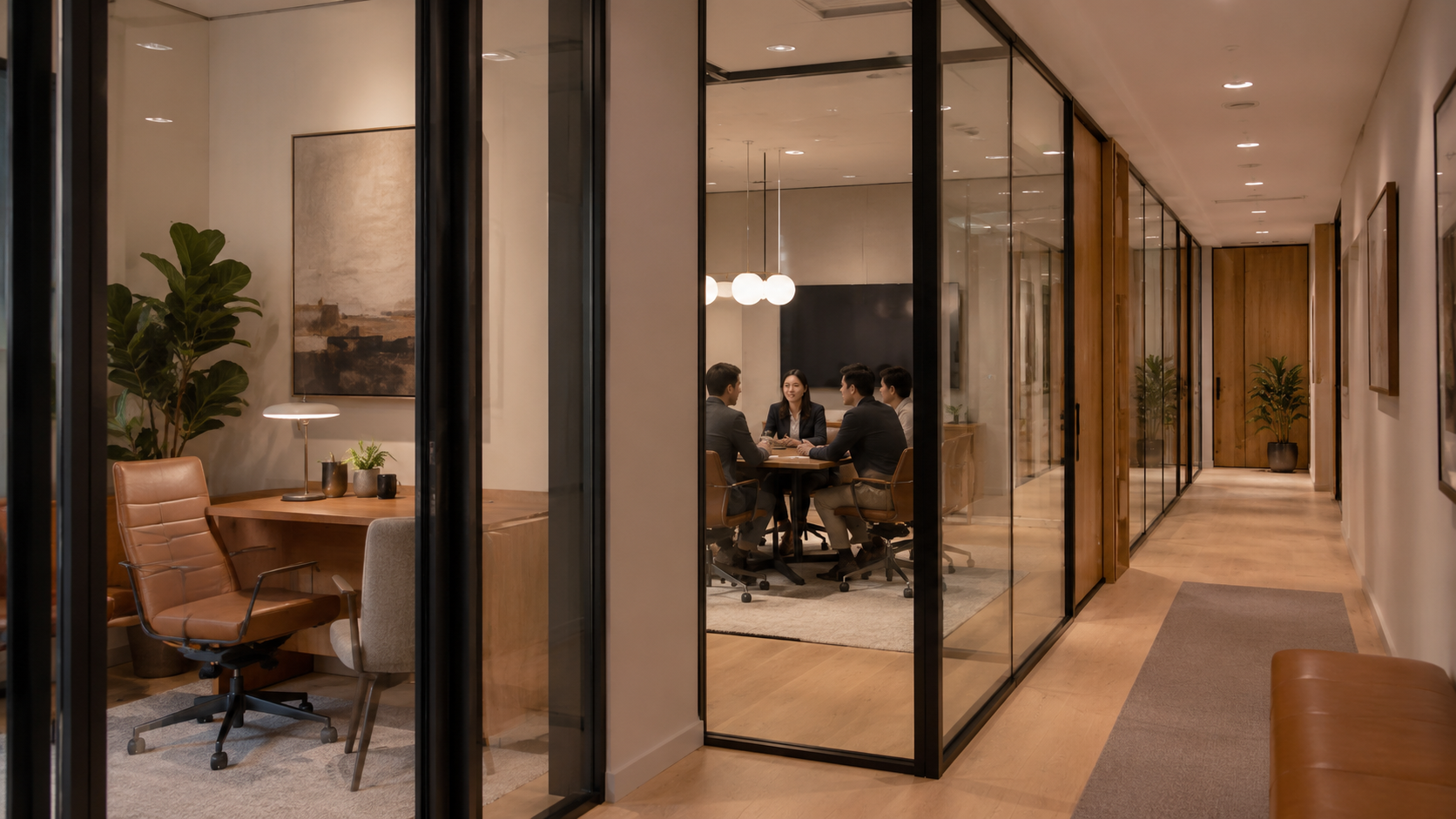
The point of coworking is that the workspace is ready to use. A membership normally covers high-speed Wi-Fi, a desk and ergonomic chair, access to meeting rooms, printing, a kitchen with coffee, and cleaning and utilities. Better spaces add quiet zones and phone booths for focused work and calls, lockers, and event programming. Because dozens of members share the cost of these amenities, each person gets a far more complete setup than they could afford alone — which is much of coworking’s appeal.
Who uses coworking spaces?
Coworking started with freelancers, but its members today are far broader. Independent workers and consultants use it for a professional base and a place to meet clients. Remote and hybrid employees use it to separate work from home and to escape the isolation of the kitchen table. Startups and small teams get an instant office without capital outlay or a long lease, and can add desks as they hire. Increasingly, large companies take coworking memberships as satellite offices — a way to give staff a workplace in a new city without signing for a whole floor. And digital nomads rely on coworking for reliable internet and a community wherever they land.
Coworking vs a traditional office
The clearest way to understand coworking is to compare it with the alternative. A traditional office means a multi-year lease, your own fit-out, and responsibility for utilities, furniture, internet, and maintenance — in exchange for full control and your own branding on the door. Coworking flips that: you trade some control for flexibility, move in the day you sign, and pay one predictable membership that includes the running costs. You can scale up or down with a short notice period instead of being locked in.

That flexibility is the headline benefit, but it isn’t the only one. Coworking usually costs less than running an equivalent private office once you count utilities, equipment, and the long lease. It puts you in a community that can turn into clients, collaborators, and friends. And it removes the overhead of managing a workplace, so you can spend your attention on the work itself. The trade-offs are real — you can’t rearrange the building, and a busy floor needs the discipline to use the quiet zones — but for most independent workers and small teams the balance favours coworking.
Common myths about coworking spaces
A few persistent ideas put people off coworking before they’ve tried it, and most of them describe the early open-plan spaces more than today’s. The first is that coworking is too noisy for real work — but modern spaces are zoned, with quiet areas and soundproof phone booths kept apart from the social floor. The second is that it’s only for freelancers and startups, when in fact corporate teams are now one of the fastest-growing groups of members. The third is that it’s expensive; measured against a private lease with its utilities, furniture, and maintenance, a membership is usually the cheaper option.
Beyond the desk: virtual offices and event spaces
Coworking isn’t only about a place to sit. The same membership ladder extends below and above the desk. A virtual office sits at the entry level: you get a registered business address and mail handling without renting a desk full time — useful for company registration, banking, and a credible presence, especially for people running a business from abroad. It’s the natural first step for someone who needs an address now and a workspace later.
At the other end, many coworking spaces host gatherings their members and the wider community need — workshops, talks, and networking evenings. That’s why a full space often includes an event space and an auditorium alongside the desks, so a member can run a launch or a lecture in the same building where they work.
Coworking in Budva: a base for remote work in Montenegro
Most explanations of coworking assume a big Western city. The model is just as useful for people relocating somewhere new — and Montenegro has become a popular base for remote workers and digital nomads drawn by the climate, the cost of living, and the Adriatic coast. A coworking space in Budva gives a newcomer the two things hardest to arrange from scratch in another country: a reliable, fast place to work, and a ready-made community of people doing the same thing. For anyone weighing a move, a local space is also the simplest way to test the city before committing to it.
Is coworking right for you?
Coworking is, at heart, a simple trade: you give up the control and permanence of your own office and get flexibility, a complete workspace, and a community in return. If you work independently, lead a small or growing team, or just want somewhere better than home without the weight of a lease, it likely fits. The best way to find out is to spend a day in one. If you’re in or heading to Budva, you’re welcome to try MONTECO for a day and see how coworking feels before you decide.
Frequently Asked Questions
What is a coworking space?
A coworking space is a shared, fully equipped workplace where people from different companies work on flexible membership terms instead of a long lease. The membership covers the desk, internet, meeting rooms, and utilities, so the space is ready to use the day you join.
What does coworking mean?
Coworking means working independently on your own projects while sharing a workspace, its facilities, and its community with people from other companies. The term refers both to that way of working and to the space itself.
How does a coworking space work?
You pick a membership that matches how often you’ll be there — a hot desk, a dedicated desk, or a private office — and use the space under that plan. The operator handles internet, furniture, cleaning, and utilities, and you book meeting rooms as you need them.
Who uses coworking spaces?
Freelancers, remote and hybrid employees, startups, growing teams, corporate satellite offices, and digital nomads. The common thread is people who want a professional workspace without a long-term lease.
What’s the difference between coworking and a traditional office?
A traditional office means a multi-year lease and responsibility for fit-out, furniture, and utilities, in exchange for full control. Coworking gives you a ready-to-use space on a flexible membership that includes those running costs, so you can move in immediately and scale up or down.
What’s the difference between a hot desk and a dedicated desk?
A hot desk is any free seat in the open area, taken on a first-come basis and booked by the day or month. A dedicated desk is one workstation reserved for you alone, so you can leave equipment overnight and always sit in the same spot.
What’s the difference between a coworking space and a virtual office?
A coworking membership gives you a physical place to work. A virtual office gives you a registered business address and mail handling without a full-time desk — useful for company registration and a credible presence — often with a few coworking days included so you can use the space when you need it.



Leave a Reply